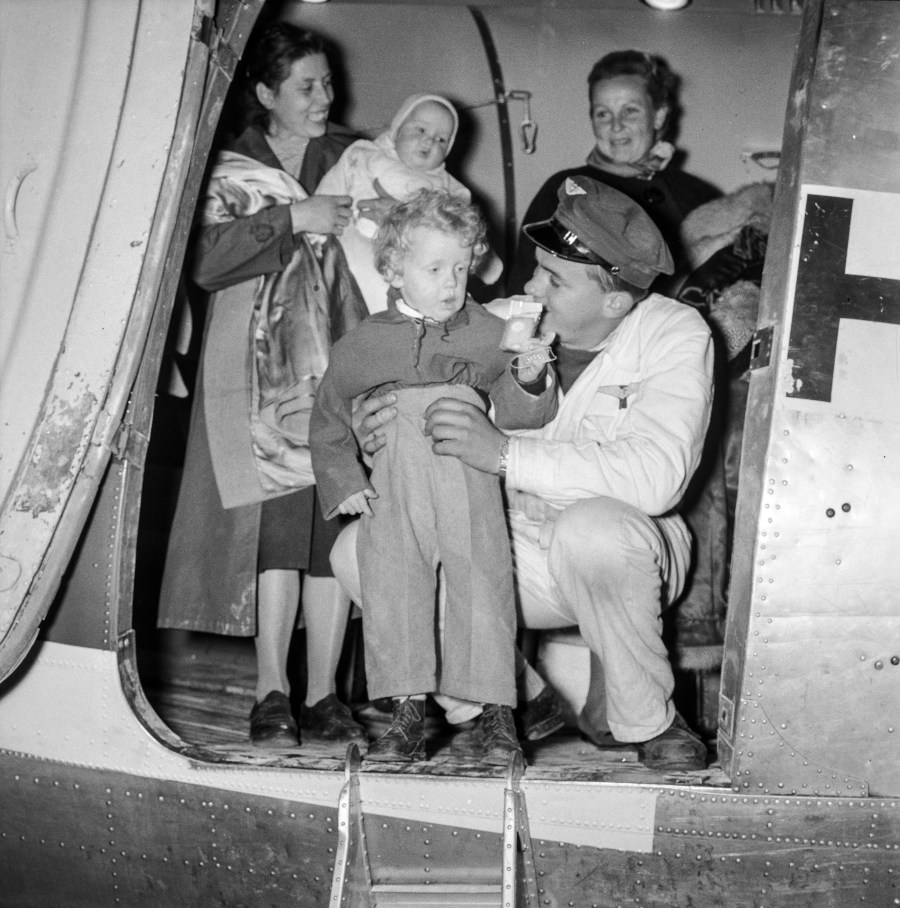
I was recently asked the perennial graduate school question: “What do you do?” While my answer was much shorter, this overview of my current work seems like a good place to kickoff a short series to introduce myself. -PCL
On 23 October 1956, a Hungarian student-led march in support of their Polish confreres swiftly turned into a demonstration, then a protest, to a mob, and finally to a revolt. Within a week, the both the government and communist party had collapsed, replaced by an interim government still processing the events. A Soviet-led military intervention the following week led to bitter street fighting, the eventual arrest of the interim government, and the flight of approximately 200,000 Hungarians to neighboring Austria and Yugoslavia. The steady flow of refugees ultimately resulted in around 180,000 men, women, and children arriving in Austria. Overwhelmed, and concerned about protecting its recently won neutrality, Austria appealed to the UN for assistance, thus initiating a global process of resettlement that would greatly expand the Hungarian diaspora.
Meanwhile, daily life continued for a Hungarian American community more concerned about the imminent 1956 Presidential election than of events in their homeland. Slowly, news trickled into diaspora communities about the events in Hungary, yet it was confusing and delayed. By the time they fully understood what was happening, the revolt was all but crushed, and saddened by the events, many prepared for a “Black Thanksgiving.” It was at this moment that President Eisenhower announced the acceptance of the first group of Hungarian refugees, many of whom celebrated their first Thanksgiving in a US military mess hall. As the full scope of the refugee problem came into focus, the Eisenhower administration increased refugee admission quotas and ultimately established a presidential committee to expedite and oversee a relief effort that would resettle over 32,000 Hungarians within six months. Moreover, amid a resurgence of immigration restrictionism and anti-communism, the American people rallied in support of the Hungarians, many of whom had actual Communist affiliations. These responses to the Hungarian Crisis point to a historical narrative that is largely missing from the histories of the United States and the Cold War.
Previous scholars writing about these events largely focus on one of two themes: the role of the Hungarian Uprising in US-Soviet relations or how the refugee resettlement project fits within the scope of 20th Century immigration in the United States. In the former category, scholars like Joanna Granville, Charles Gati, and Laszlo Borhi primarily address the Hungarian Uprising as a moment of heightened international tensions during the early days of the US-Soviet rivalry known as the Cold War.[1] Such scholarship tends to focus on the implied questions about the inevitability of the Soviet response and the moral responsibility for US foreign policy rhetoric. Unfortunately, in these narratives the Hungarians at the center of the story often become minor participants whose actions are determined by a larger, external geopolitical power. The second category, featuring scholars like Carl Bon Tempo and Stephen Porter discuss the resettlement of Hungarian refugees in the United States within the context of immigration history.[2] For these works, the Cold War is context, and the Hungarians are passive beneficiaries of American largess. While both genres provide excellent historical insights and interventions, they effectively relegate the central characters, the Hungarians, to unnamed extras in the background.
My dissertation, “Hungarians Over Here: Diaspora, Refugees, and US Cold War Politics,” considers how diaspora participated in a global Cold War by examining the responses of the Hungarian American community to the resettlement of Hungarian refugees. In that moment we find Hungarians as both the recipients of a global relief effort and key contributors to the success of those efforts. My project focuses on the role of diaspora institutions—Hungarian civic and cultural organizations—as active participants in local events with global consequences and global events with local effects. During the immediate refugee crisis, these institutions mobilized the Hungarian American community for participation in resettlement work at home and abroad. Afterwards, those same institutions worked to pressure policymakers for preferred outcomes on issues like immigration, US-Hungarian relations, and the status of Hungary in the United Nations, by using Cold War rhetoric to link their status as Cold War “freedom fighters” with “Americanness.”
By highlighting the role of the Hungarian diaspora during this period, I make several interventions. First, by focusing on the Hungarian American community, many of whom were postwar immigrants, it becomes possible to create a Hungarian-centered narrative of the 1956 Uprising and its subsequent refugee crisis. The interlocking and concurrent nature of these events, as well as their global scale, reveal a single Hungarian Crisis with Hungarians as the primary actors in the uprising, the flight, and the resettlement. Second, while such a crisis would have global reverberations, the Cold War produced distinct effects. In Hungary, anti-Soviet sentiment—not anti-Communism—fueled the uprising, while the diaspora employed the anti-communist rhetoric of the Cold War to garner social and political support for the refugees. By focusing on the US-Soviet context, previous scholarship overlooked the ways the Hungarians consciously participated in that conflict.
The Hungarian Crisis affected the Hungarian community regardless of locality. For the Hungarian diaspora, the crisis involved family, friends, and neighbors in their homeland and in their local communities. While in Hungary, the “counterrevolution” hung over the communist successor state for its entire duration and played a role in its demise. Even today, Hungarians, at home and abroad, observe October 23 as one of the major patriotic holidays, a memorial to moment of resistance to oppressive foreign influences.
[1] Johanna C Granville, The First Domino: International Decision Making during the Hungarian Crisis of 1956 (College Station: Texas A & M University Press, 2004); Charles Gati, Failed Illusions: Moscow, Washington, Budapest, and the 1956 Hungarian Revolt(Washington D.C.: Woodrow Wilson Center Press, 2006); László Borhi, Dealing with Dictators: The United States, Hungary, and East Central Europe 1942-1989. (Bloomington: Indiana Univ Press, 2016); László Borhi, Hungary in the Cold War, 1945-1956: Between the United States and the Soviet Union (New York: Central European University Press, 2004).
[2] Carl J. Bon Tempo, Americans at the Gate: The United States and Refugees during the Cold War (Princeton: Princeton University Press, 2008), https://doi.org/10.2307/j.ctt7rj3n; Porter, Benevolent Empire.
 Patrick C. Leech
Pingback: What I Do: Why Hungary – Patrick C. Leech