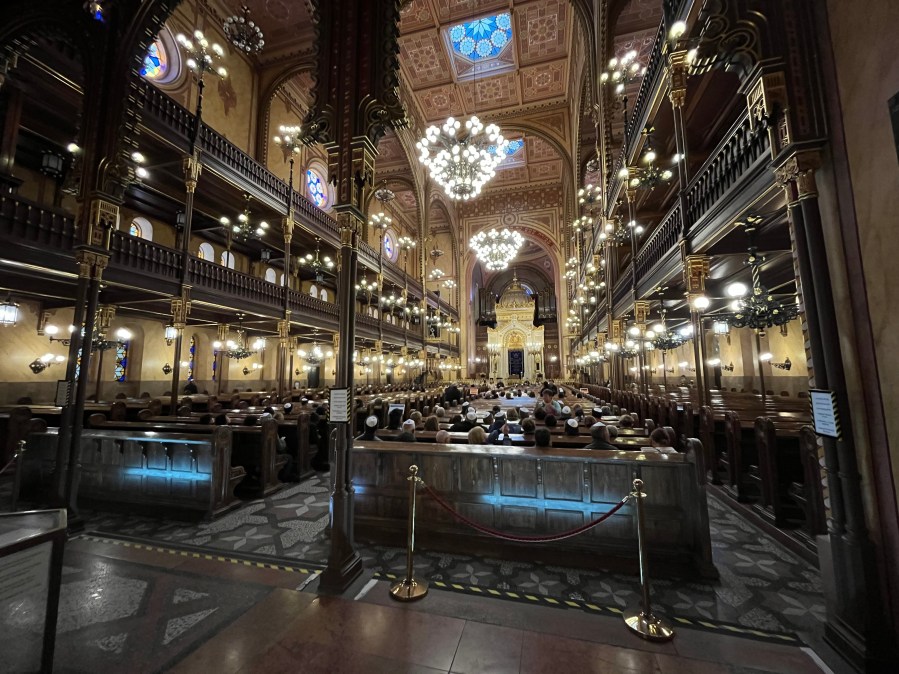
On Monday, I met up with friend to visit the Dohanyi utca Synagogue and Holocaust Museum. The synagogue is the largest in Europe and features several unusual design elements that reflect the unique theology of the congregation. The lovely building was initially completed in 1859 and features a large pipe organ and multi-level seating with the women sitting in the gallery.
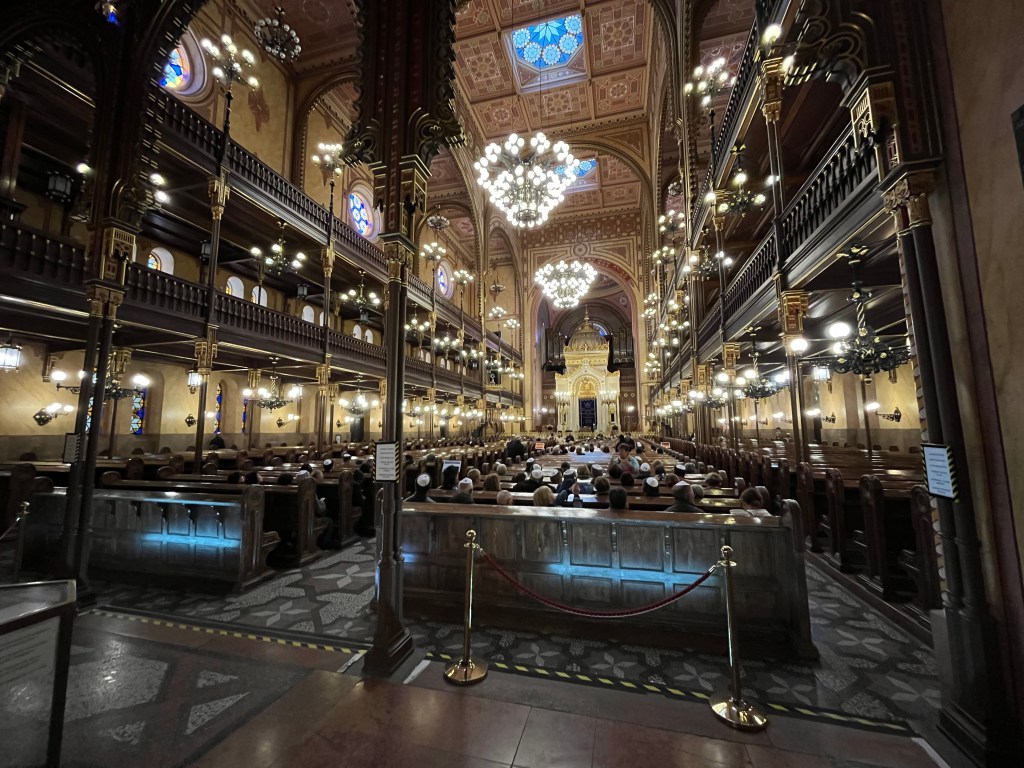
Known as Neologs, these Jewish Hungarians viewed themselves as culturally Hungarian and religiously Jewish yet are theologically between the more liberal Reformed and the more conservative Orthodox communities. As such, Neolog Judaism only exists within areas previously part of the Kingdom of Hungary. Moreover, the Neolog embrace of Hungarian culture created unique opportunities for the Jewish communities in Hungary which experienced higher levels of social and economic acceptance, despite the rise of political antisemitism. An example of this is the “Hősök templom” (Heroes Temple) which was built in 1931 to memorialize the Jewish soldiers from World War I and as a reminder to the non-Jewish Hungarians of the community’s patriotism and loyalty to Hungary.
During World War II, the synagogue became central to the Jewish community of the Budapest Ghetto. Because of alliance between Hungary and Germany, the Hungarian Jewish communities were initially spared from ghettoization and deportations, although antisemitic laws did subject the Jewish community to harassment, arrests, and other forms of abuse. That dramatically changed following the Nazi occupation of Hungary in March 1944 to prevent Hungary pursuing a separate peace with the Allied Powers. In Budapest, the Jewish community was forced into ghettos or into Yellow Star Houses. While in outlying areas, a small contingent of Nazis, led by Adolf Eichmann, with the cooperation of numerous Hungarian civil servants deported nearly 500,000 Hungarian Jews in less than eight weeks to the death camps like Auschwitz, Buchenwald, and Bergen-Belsen. Political and military changes in June 1944 halted the mass deportations before the Budapest’s Jewish communities were transported. Yet, the impending resistance to the oncoming Red Army led Berlin to completely takeover the Hungarian state in the Fall 1944. Between the Battle of Budapest, the killing sprees of the organic Hungarian fascist Arrow Cross party, and the harsh winter, thousands of members of Budapest’s Jewish community died.
Many of these victims were left in the streets when the Red Army liberated the city. To prevent disease, the Red Army ordered mass burials and forced the surviving Jews to violate their own religious principles to do so. Most famously, thousands were buried in the garden of synagogue. Even today, their exact number and the identities remain unknown. Today, that garden cemetery is lined with the names of missing Hungarian Jews, yet there is no direct relationship between those names and those buried there.
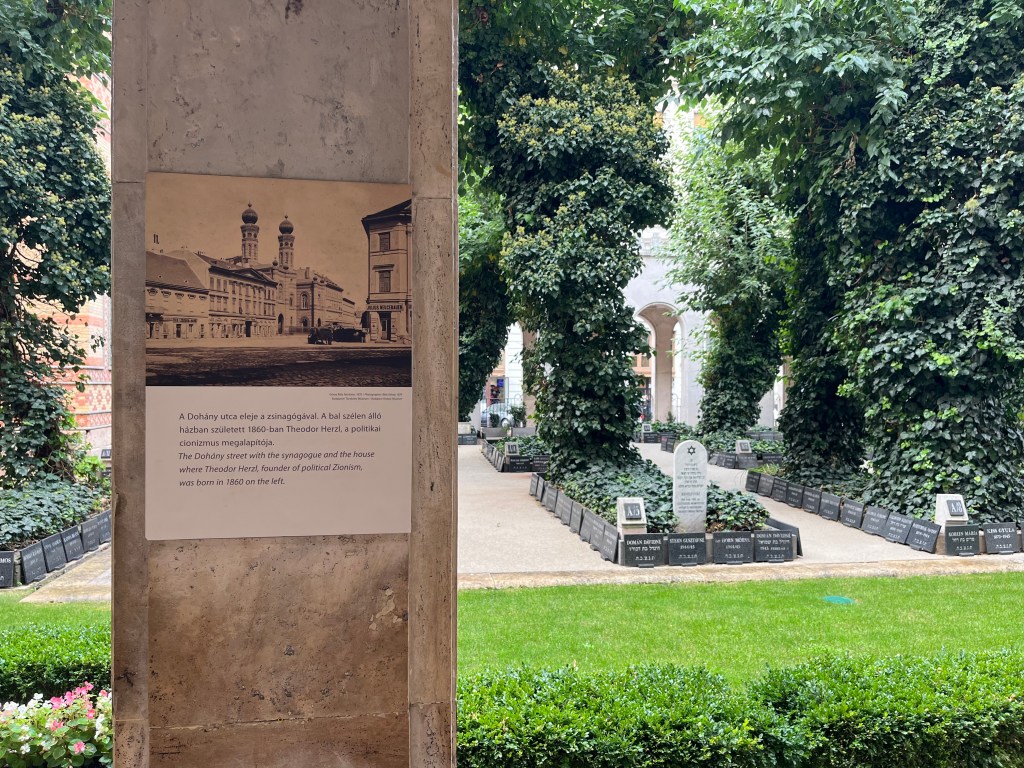
On the column in that picture is also a reference to Theodore Herzl. Herzl, born in a house adjacent to the Dohanyi utca Synagogue in 1860, is the founder of modern political Zionism, the idea that to fully flourish Europe’s Jewish population needed its own political state. This eventually evolved into the calls for the establishment of the modern state of Israel.
Visiting this synagogue on the cold and rainy Monday after the horrific attacks by Hamas can only be described as surreal. There I encountered a space that memorialized the past and present life of the Hungarian Jewish community, the most infamous effort to destroy that community, and the birthplace of the intellectual father of the state of Israel while following news reports about atrocities committed by another murderous, antisemitic group.

 Patrick C. Leech