
Happy Thanksgiving!
My apologies for the hiatus, my work here picked up sharply but now I hope to return to the usual weekly posts. -Patrick
Due to the timing of the 1956 Revolution, the Hungarian refugee crisis started at the beginning of the American “holiday season”—Thanksgiving through Christmas. This timing proved fortuitous as the refugees and various relief efforts benefited from the increased generosity that traditionally marked this season.
That timing also meant some of the first Hungarian refugees experienced the Thanksgiving holiday. While celebrations of successful fall harvests occur in Hungary, they tend to be local festivals. But American-style Thanksgiving is something that would have been completely foreign to those refugees, something I have only began to comprehend as I spend Thanksgiving in Hungary.
Part of the strangeness was the lavishness. The bountiful feast traditionally associated with Thanksgiving was difficult for many in the US, but almost incomprehensible even in Europe. Today we might marvel at the sparseness of the 1943 table in Norman Rockwall’s “Freedom from Want,” it was lavish compared to its European counterparts. For example, Great Britain started rationing in 1940 as part of the war effort and while it gradually receded, the rationing of meat and food stuffs continued until 1954. In places like France, Germany, Poland, and Hungary where the war caused more severe industrial and agricultural disruptions, shortages and forms of rationing persisted.
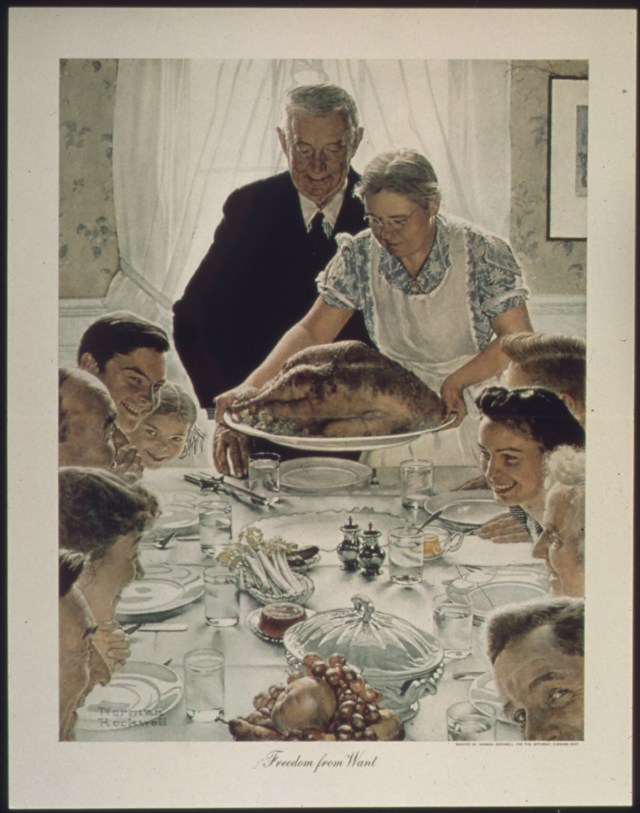
Now imagine how shocking it would be to have fled your homeland, forsaking most of your meagre possessions to then arrive in yet another dilapidated former military camp in yet another foreign country to then be greeted with an American Thanksgiving dinner. Much was made of this “First Thanksgiving” and its parallels to a mythologized American past. While the Americanization component is an interesting topic for discussion, it also misses a larger point.
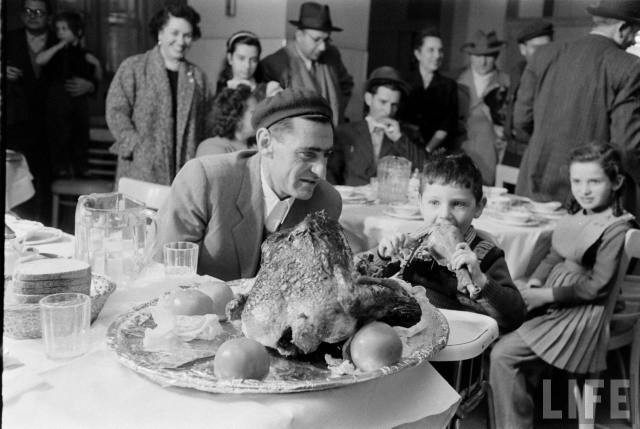
by Carl Mydans for LIFE Magazine
Part of why I find this refugee relief story so compelling is that it captures one of the best elements of American culture, our collective capacity of generosity even to strangers. For me, part of this story is a reminder to myself and other Americans of the importance of that radical generosity.
In my history classes, my students learn that myths are the stories a society tells itself about itself; as such, myths are not inherently true or false, rather, they often point toward some source of collective identity or values. The differences between the First Thanksgiving and its mythologized version are real and significant, yet the reminder to collectively and individually practice gratitude, generosity, and hospitality is of immense value.
 Patrick C. Leech
Pingback: What is history and why does it matter? – Patrick C. Leech