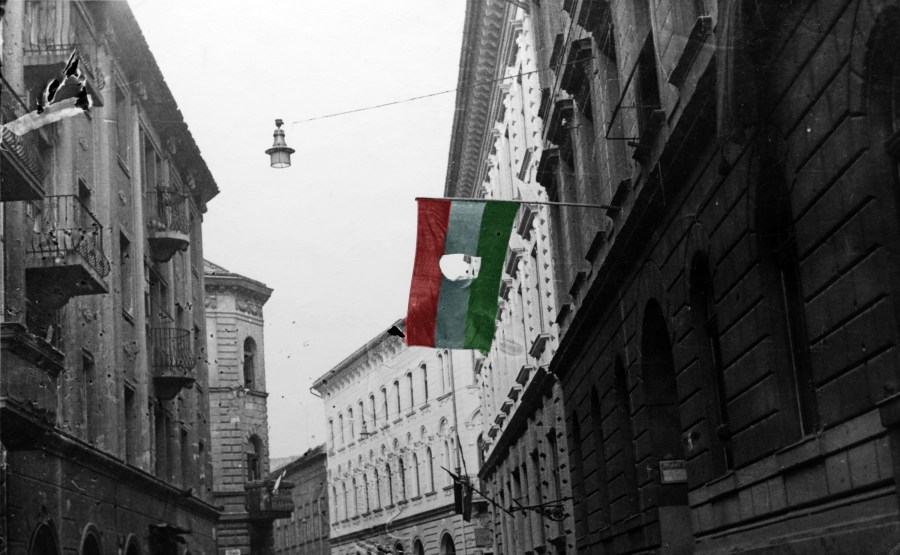
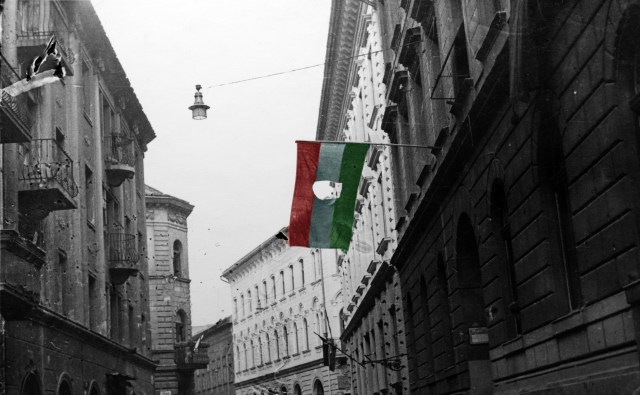
On October 23, 1956, university students in Budapest, Hungary organized a march in solidarity with the anti-Soviet events in Poland. The students were joined by workers and other residents of Budapest and eventually over 20,000 people demonstrated in favor of political reforms in socialist Hungary. This demonstration sparked what is known as the Hungarian Uprising. During the revolt, many Hungarians cut the crest of the Hungarian People’s Republic – which featured the hammer and sickle – out of the national flag. This became the flag of anti-Soviet groups until the revolt was quelled in late-November.
These “holed” flags remain a symbol of the revolt and opposition to the Soviet system. In 1988, as Hungary began a state-sanctioned political reform, the holed flag was again present. Yet, now these flags were not defaced banners but a product – note that the hole is only in the white stripe whereas the state crest spanned all three stripes.


The holed flag came full circle in 1990 during the height of the post-socialist political reform. Here students march to Bem Square with a wreath, imitating the actions and steps of their predecessors in 1956. At the head of the procession is the holed flag. Poignantly, in 1956 and again in 1990 their path paralleled the Danube across from the Hungarian Parliament building where the new government officially recognized the revolt for the first time.
Recently, some of my students learned about the May Fourth Movement in the nascent Republic of China in 1919. That too was a student-led demonstration in favor of political reform (and many other grievances). That movement inspired Chinese students 1989 when students initiated a weeks-long demonstration in Tiananmen Square that was ultimately brutally crushed on June 4, 1989. Other protests in Central and Eastern Europe in 1989 contributed to the pressures that ripped open the “Iron Curtain,” these drew upon previous efforts in 1956, 1968, and 1977. Students played a significant role in the Iranian Revolution (1979) and in Arab Spring protests in 2011. They also contributed to the Maidan Revolution of Dignity in Ukraine (2014) and to the “Women, Life, Freedom” protests in Iran in the wake of the beating death of Mahsa Amini (2022).
Last week, many cities in the US witnessed “No Kings” protests led by students and others opposed to the current government’s policies. One impetus for these protests has been heavy-handed responses to earlier ones and this brings us back to Hungary in 1956. In most of the instances mentioned, including 1956, armed responses to escalated the demonstration into a crisis. In Budapest, the demonstration moved across the Danube to the Parliament building and while their prolonged demonstration rattled a fragile government, the crowds dispersed in the early hours of 24 October. Parallel to the peaceful demonstration at the Parliament building, several blocks away armed resisters famously tore down the Stalin statue while others attempted to forcibly enter the state radio building where a gunfight ensued. The arrival of Soviet Army units into Budapest later that day reignited the tensions as armed resisters attacked some security forces, primarily the state police.
This precarious peace set the city on edge, yet a peaceful demonstration on 25 October witnessed Soviet troops and tanks escorting Hungarians back to the Parliament building. The demonstrators, including a large number of women and children, along with the Soviet forces occupied the square in front of the Parliament while Hungarian security services took positions on roofs of building around the square. Tragically, a shot was fired (the details of this shot are highly disputed and likely lost to history) yet the result was that Soviet and Hungarian forces opened fire on each other and the civilians in the square. The ensuing violence resulted in dozens of deaths, hundreds of injuries, and tipped the city and country into full revolt.
The lyukas zászló is a symbol of the Hungarian Uprising and of the people of Hungary to govern themselves. Yet, it is also a reminder that government responses to public demonstrations can be the difference between peaceful reform and violent revolt.
 Patrick C. Leech