
On September 1, the New York Times carried an article about the new Russian history textbook and its descriptions of Ukraine and the ongoing “special military operation.” The next week, The Hill, a US political news site ran a similar piece. Both panned the new textbooks as inaccurate and propaganda. Unless you closely follow US politics or Eastern Europe, it is likely that you missed these pieces and the whole affair. Even if someone read these or similar pieces, they would not know that this caused a stir outside of Ukraine and its supporters.
Yet, this textbook as sparked a minor diplomatic and political row within Hungary, for a different but related reason. In late August, Telex, a Hungarian news site, reported on the new textbook and its Soviet-style description of the failed 1956 Revolution. The reporter contacted the Russian Embassy in Hungary who denied the characterization of the textbook and claimed that the purported images were fake. So, Telexobtained a hardcopy of the textbook.
The new textbook, designed for 11th grade students, includes this summary of the 1956 Revolution:
“During the uprising, the insurgent radicals – many of whom had previously been fighters in the then fascist Hungary’s armed forces – ‘made a name for themselves’ not only by vandalizing Soviet monuments and symbols, but also by committing countless murders of representatives of the Hungarian Workers’ Party, members of the law enforcement agencies, and their own families. There were even conscripted soldiers protecting [prisons and military] [sic] facilities among the victims of the inhumane massacres.”[1]
Additionally, the text justified the Soviet Army intervention saying:
“The demonstrators criticized the Hungarian leadership for its pro-Soviet stance, demanding Hungary’s withdrawal from the Warsaw Pact. Being fully justified in assuming that the catalysts for the crisis in Hungary were Western secret services supporting the internal opposition, the Soviet Union deployed troops to Hungary, to assist the Hungarian authorities in suppressing the action.”[2]
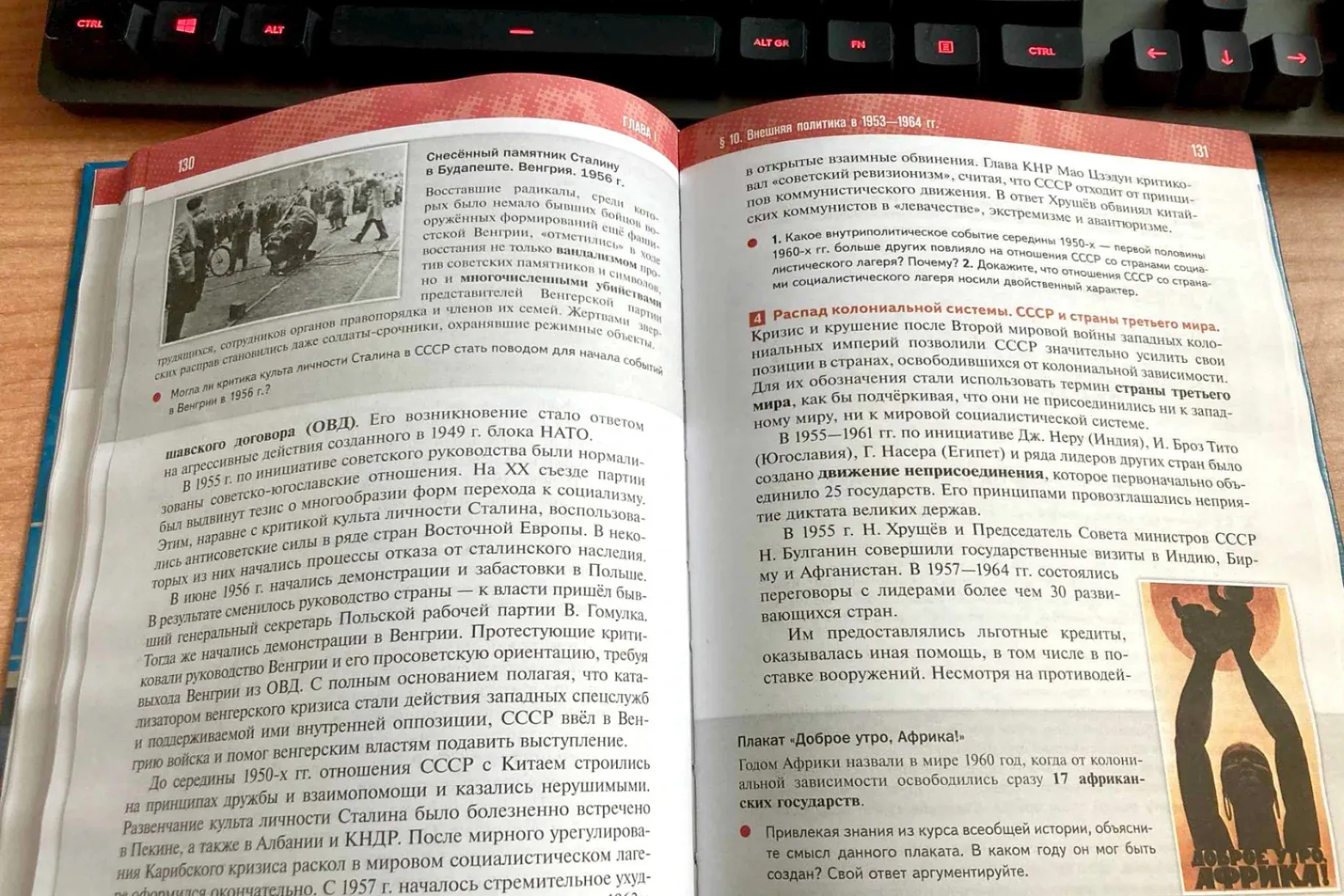
Admittedly these are not quite Soviet-era descriptions because the most important word is missing: counterrevolution. Both the Soviet Union and the Communist Hungary described the events of 1956 as a counterrevolution, meaning an attempt to overthrow the socialist revolution that occurred in Hungary in 1948, otherwise Yuri Andropov could have written this.[3]
The 1956 Revolution is an important moment in Hungarian national identity and to the existence of the post-communist state. A young Viktor Orbán controversially made his political debut by giving a speech at the 1989 reburial of Imre Nagy (the executed leader of the interim government during the revolt) and October 23, the anniversary of the first day of the revolt, is a national holiday. As such, the Hungarian government has taken a dim view on those who impugn the revolutionaries. For instance, in 2016, a Russian television program implied the rebels were Nazis, the then Foreign Minister summoned the Russian Ambassador who protested that the program did not reflect the views of the Russian state. The Hungarian Foreign Minister, Péter Szijjártó went on to issue a statement saying, “we will not tolerate anyone talking about the 1956 revolution and its heroes in a humiliating way.”[4]

Credit:Istvan Csaba Toth/MTI, via Associated Press
This new textbook goes much further; it not only describes the Hungarians as fascists, but it does also so in the same terms as used to justify the ongoing Russian invasion of Ukraine. This puts the Orbán government in a precarious position. Orbán has walked a controversial line within both NATO and the EU regarding Russia. This is partly from an ideological affinity, partly in the hope of getting cheaper Russian gas, and also out of protest of Ukrainian treatment of Hungarian minorities caught up in legal changes aimed to reduce Russian influences within Ukraine. Yet, this textbook pits Orbán’s nationalism against Putin’s nationalism while also aligning the former with Ukraine.
Aware of this Telex sought comment from Hungarian officials and received only mild pushback on the Russian narrative from a subordinate member of the Foreign Ministry, yet without any condemnation of Russia. Meanwhile, during the Eastern Economic Forum in Vladivostok, Russian President Putin responded to a moderator’s comment about the Soviet suppression of Hungary and Czechoslovakia by describing the Soviet policies as “flawed.”[5] While the textbooks are not likely to alter Hungary’s current relations with Russia, the responses, or lack thereof, are notable.
Rarely do textbooks make international news much less cause a minor diplomatic disturbance. Unsurprisingly, the Hungarian aspect of this textbook feud did not make the US news cycle; the Ukrainian facet only did because of the widespread support for Ukraine in the current invasion. Nevertheless, this incident is a reminder of the complex, interconnected histories of this region and that Hungary is often more relevant than we think.
[1] Gergely Nyilas and Bálint Nagy, “We Obtained the New Russian History Textbook – It Really Says That Fighters of Former Fascist Units Were behind Hungary’s 1956 Revolution,” trans. Andrea Horváth Kavai, Telex, September 1, 2023, sec. English, https://telex.hu/english/2023/09/01/we-obtained-the-new-russian-history-textbook-it-really-says-that-fighters-of-former-fascist-units-were-behind-hungarys-1956-revolution.
[2] Nyilas and Nagy.
[3] Yuri Vladimirovich Andropov (1914-1984) was a career KGB agent, served as the Ambassador to Hungary from 1954-1957, and rose to become one of the last General Secretaries of the Communist Party of the Soviet Union. His role in encouraging military intervention in 1956 earned him the nickname the “Butcher of Budapest.” Moreover, his experiences in 1956 shaped his response to events in Czechoslovakia in 1968 and later.
[4] Vilmos Weiler, “The Russian Textbook Referring to 1956 Revolutionaries as Fascists Reveals How Strongly the Hungarian Government Has Chained Itself to Putin,” trans. Andrea Horváth Kavai, Telex, August 30, 2023, sec. English, https://telex.hu/english/2023/08/30/the-russian-textbook-referring-to-1956-revolutionaries-as-fascists-reveals-how-strongly-the-hungarian-government-has-chained-itself-to-putin.
[5] Gergely Nyilas, “Putin: The Soviet Union Made a Mistake in 1956 When It Sent Its Tanks into Budapest,” trans. Andrea Horváth Kavai, Telex, September 12, 2023, sec. English, https://telex.hu/english/2023/09/12/putin-the-soviet-union-made-a-mistake-in-1956-when-it-rolled-its-tanks-into-budapest.
 Patrick C. Leech